
Home › ADA & Handicap Automatic Doors
ADA automatic doors, specified to the opening
Low energy operators, touchless actuators, sensors and full power entrances for commercial properties across Miami-Dade. We measure the opening before we quote the hardware, because the measurements decide what is actually compliant.
Book a site measure
Tell us which opening you are looking at and a dispatcher calls you back.
Why the opening matters
The ADA does not require an automatic door. It requires a compliant opening.
That distinction decides most projects. Section 404 of the 2010 ADA Standards for Accessible Design sets what an accessible door has to deliver: a clear width of at least 32 inches, a threshold no taller than half an inch, and hardware operable with one hand at no more than 5 pounds of force. It does not tell you which product to buy.
Where buildings run into trouble is that last figure. Heavy exterior doors, doors with strong closers, and fire-rated assemblies frequently cannot be pulled open at 5 pounds of force while still closing and latching the way they are supposed to. A low energy power operator resolves that conflict without gutting the entrance, which is why it is the most common accessibility retrofit we install in Miami-Dade.
It is also why measuring comes first. If an opening is 30 inches clear, no operator on the market makes it compliant. We would rather tell you that on the site visit than after the invoice.
The numbers
What a compliant opening has to hit
The figures below are the ones that decide whether an entrance passes. Bring them to any quote you receive, from us or anyone else.
| Requirement | Figure | Notes |
|---|---|---|
| Clear opening width | 32 in. minimum | Measured with all leaves open. Openings deeper than 24 in. need 36 in. |
| Threshold height | 1/2 in. maximum | Anything over 1/4 in. must be bevelled at a slope no steeper than 1:2. |
| Hardware operating force | 5 lbf maximum | Operable with one hand, without tight grasping, pinching or wrist twisting. |
| Break-out opening | 32 in. minimum | Required on egress doors without standby power, measured in emergency mode. |
| Actuator reach range | Within accessible reach | Push plates and wave sensors placed clear of the door swing arc. |
| Signage | Per ANSI/BHMA | A156.10 places automatic-door signage at 50 in. from the floor to the sign centre line. |
What we install
Systems that make an entrance accessible
Low-energy swing operators
The workhorse of ADA retrofits. Activated by a knowing act, a push plate or wave sensor, and governed by ANSI/BHMA A156.19, which sets opening time, closing force and kinetic energy limits. The right answer for most restrooms, vestibules, offices and clinic entries.
Full-power sliding and swinging entrances
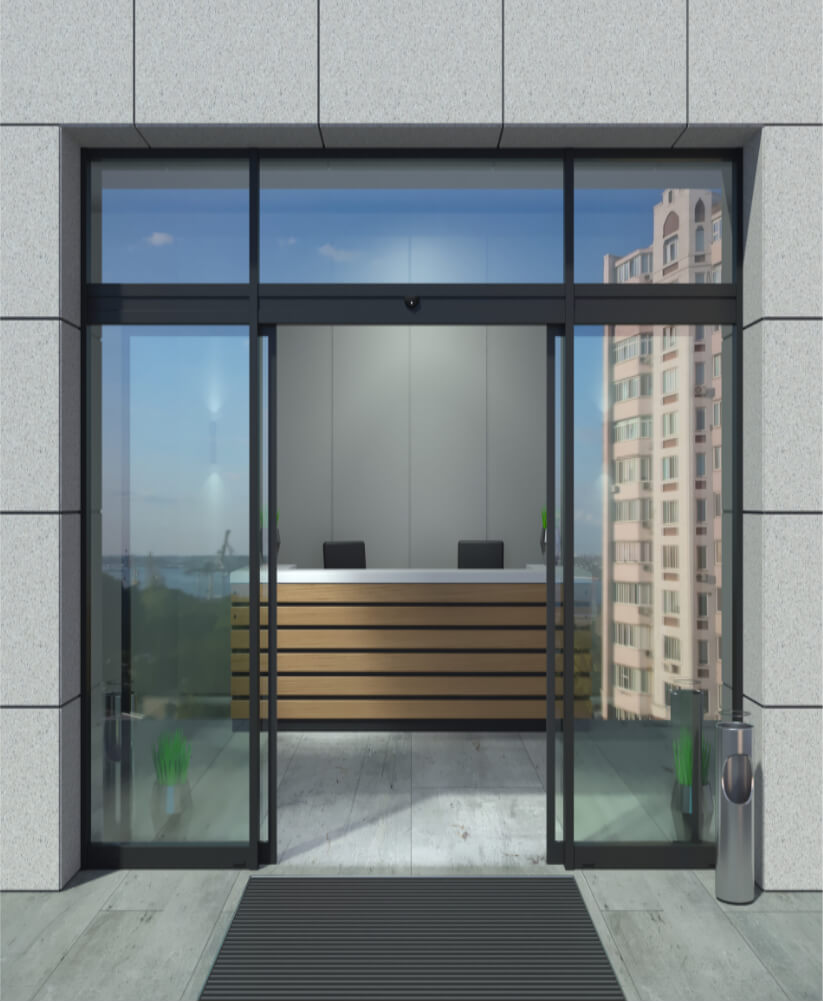
Motion-activated pedestrian entrances under ANSI/BHMA A156.10, with presence sensing on both approach and swing sides. Used where traffic volume is high and hands-free travel is expected.
Push plates, wave plates and touchless actuators
Hardwired or wireless, in stainless, brushed aluminium or bollard-mounted. Touchless actuators have moved from a nicety to an expectation in medical and food-service buildings.
Operator retrofits on existing doors
An existing manual door frequently accepts a low-energy operator without replacing the leaf or the frame, which is the least disruptive route to a compliant opening.
Sensors, safety beams and guide rails
Presence and approach sensing, threshold beams and guide rails, set up and tested as a system rather than swapped part by part.
Access control tie-ins
Card, fob, keypad or access control release wired into the operator, including intercom and telephone entry, so a credential and the actuator work together instead of fighting each other.
Keeping it compliant
An automatic door is a safety device, and it drifts
Closing speed and force move out of specification as an operator ages. Sensors lose sensitivity. Signage falls off. None of it announces itself, which is why the automatic door industry is built around a two-part routine.
Annual inspection by a qualified inspector is tied to compliance with the ANSI/BHMA standards covering automatic doors. Between those inspections, AAADM recommends a daily safety check carried out by the building owner or whoever is responsible for the equipment: confirm the activating and safety sensors respond, watch the door open and close without impact, check the threshold and guide rails are intact and secured, verify the safety signage is present, and clear anything obstructing the traffic path.
Access Experts 247 services and repairs automatic door systems across Miami-Dade and can take on the maintenance cycle for a portfolio of buildings. If your inspection log has lapsed, restarting it is straightforward. You can see examples of our door and gate work in our recent projects.
What we get called for
The failures we see most
The door opens but closes too fast or too hard
Closing speed and force drift out of spec as an operator ages. This is the single most common finding on an out-of-compliance door, and it is a safety issue before it is a paperwork issue.
The actuator works intermittently
Usually a wireless transmitter losing sync, a failing push plate, or a low battery in the actuator, not the operator itself.
The door reopens for no reason
A presence sensor reading a reflective floor, a moved planter, or drifting sensitivity after a power event.
The door is dead but has power
Control board, motor or limit-switch failure. We carry operators, boards and micro limit chips on the truck. This is standard automatic door repair work.
The door no longer breaks out
On an egress door without standby power this is a code failure, not an inconvenience.
Nobody can find the inspection record
Annual inspection and daily safety checks are how a facility demonstrates it took the standard seriously. We can help you restart the log.
How the job runs
Measure, specify, install, hand over
-
01
We measure the opening
Clear width, threshold height, maneuvering clearance and current opening force, before any product conversation. The measurements decide what is possible.
-
02
We specify the operator
Low-energy or full power, swing or slide, hardwired or wireless actuators, based on traffic and the building type rather than on what is easiest to install.
-
03
We install and set it up
Operator, actuators, sensors, guide rails and signage, commissioned and tested as one system.
-
04
We hand over the paperwork
Setup values recorded, signage in place, and the daily safety check procedure explained to whoever will be responsible for it.
Where we work
Automatic door service across Miami-Dade
Dispatched from two South Florida locations, seven days a week, including holidays. We also cover Broward and Palm Beach. Not sure if you are in range? Get in touch and we will tell you.
- Downtown Miami
- Brickell
- Miami Beach
- Coral Gables
- Doral
- Hialeah
- Kendall
- Homestead
- Aventura
- Sunny Isles Beach
- North Miami Beach
- Countywide Miami-Dade
Questions
Before you book
Is an automatic door required by the ADA?
Not directly. The ADA sets performance requirements for accessible entrances rather than mandating a specific door type. What the standards require is a compliant opening: at least a 32-inch clear width, a threshold no higher than half an inch, and hardware that operates with one hand at no more than 5 pounds of force. Many existing doors, particularly heavy exterior doors and fire-rated assemblies, cannot meet the force requirement while still closing and latching properly. A low-energy power operator is the practical way to resolve that conflict, which is why it is the most common ADA retrofit we install.
What is the difference between a low-energy door and a full-power automatic door?
It comes down to which standard governs the operator. Low-energy and power-assist doors fall under ANSI/BHMA A156.19 and open in response to a knowing act, meaning someone presses a plate or waves at a sensor. They open slowly and with limited force, which is why they generally do not need the sensor arrays a full-power door requires. Full-power pedestrian doors fall under ANSI/BHMA A156.10, open automatically when a motion sensor detects an approach, and move faster and with more force, so they carry stricter sensing, guide rail and signage requirements.
How often does an automatic door need to be inspected?
Annually, by a qualified inspector, and that annual inspection is tied to compliance with the ANSI/BHMA standards covering automatic doors. Separately, AAADM recommends a daily safety check performed by the building owner or the person responsible for the equipment: confirm the activating and safety sensors work, watch the door open and close without impact, check that the threshold and guide rails are intact, verify the safety signage is present and legible, and clear anything obstructing the traffic path.
Can you add an operator to a door we already have?
Usually, yes. Most existing swing doors will accept a low-energy operator without replacing the leaf or the frame, provided the opening already delivers the required clear width and the door is structurally sound. We measure the opening first. If the clear width falls short, an operator will not fix it, and we will tell you that before quoting rather than after.
Do these requirements apply to an older building in Miami-Dade?
Existing buildings are treated differently from new construction, but they are not exempt. Florida enforces accessibility through the Florida Accessibility Code for Building Construction, which is built on the 2010 ADA Standards, and alterations to an area generally trigger compliance obligations for that area. If you are renovating a lobby, a restroom or an entrance vestibule, that is the moment the question of the opening comes up. Your permitting authority makes the final determination.
Related services
Other entry systems we handle
Book a site measure
We check clear width, threshold height, maneuvering clearance and current opening force, then tell you what the opening actually needs. Same day where the schedule allows.