
Roll-Up Door Repair in Miami-Dade: Commercial & Residential
Torsion springs and operator parts stocked on every service truck. Spring, operator, or curtain, diagnosed by zone and closed in a single visit.
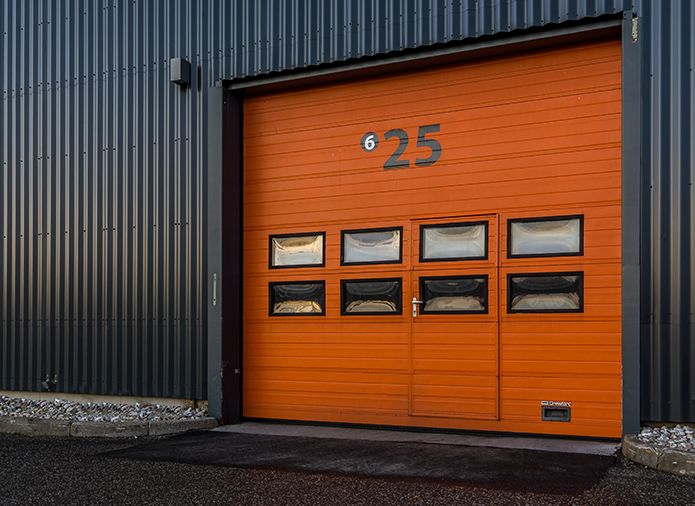
Spring System, Operator Unit, Curtain Assembly: Where Roll-Up Doors Fail
Every roll-up door failure traces back to one of three mechanical zones: the spring system, the operator unit, or the curtain assembly. Knowing which zone failed determines the repair and the cost. A spring problem doesn't get fixed by replacing the motor; a curtain problem doesn't get fixed by adjusting the limit switch.
At Access Experts 247, we break the estimate into those three zones before any work starts. You know exactly which component failed and exactly what the repair costs, nothing is bundled. That matters on commercial properties especially: a warehouse bay in Doral or a retail unit on NW 7th Avenue can't stay down while a technician figures it out on the fly. The diagnosis has to be fast, and it has to be right.
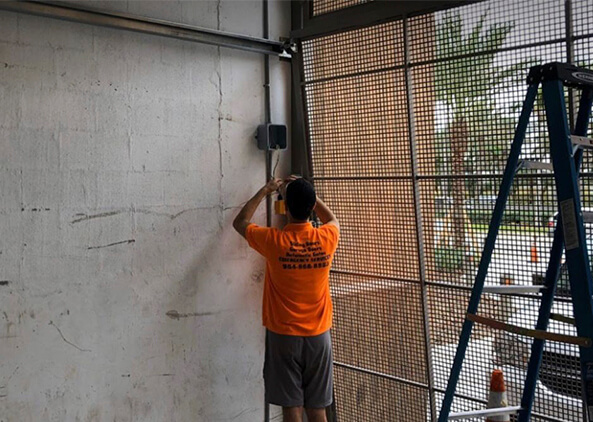
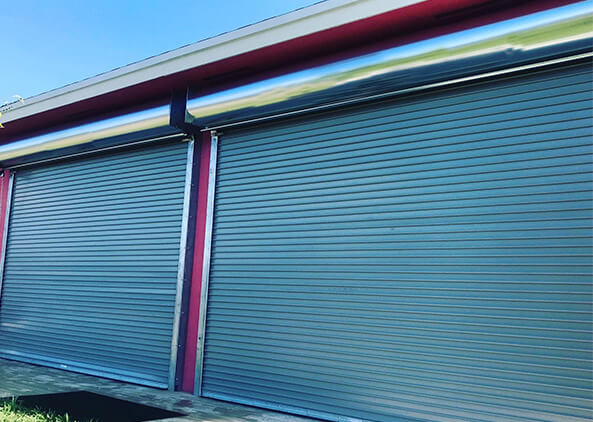
How Miami-Dade's Industrial Corridors Destroy Torsion Springs
Warehouses near Miami International Airport cycle their doors dozens of times daily; storage facilities in Hialeah run doors from 6 AM to midnight. Each cycle adds stress to the torsion spring, the coiled spring above the opening that counterbalances the curtain's weight.
Here's what most owners don't realize: torsion springs rarely give warning. The spring doesn't squeak, groan, or slow down first, it holds full tension until the moment it doesn't, and then the door simply won't lift. We've serviced roll-up systems across Miami-Dade for 15+ years, from Doral to Medley to the airport zones, and we've seen the failure patterns this climate repeats, including how salt air accelerates hardware degradation faster than inland-market owners expect.
A Door That Lifts Two Inches and Stops: What That Tells a Technician
If your roll-up door lifts two inches and stops, the spring system is the first zone to check. Partial lift followed by a hard stop almost always points to a torsion spring that lost tension or broke. The operator is getting the signal and trying to move the door, but without the spring's counterbalance, the motor can't carry the full curtain weight past those first few inches. Loading-dock calls at 3 AM are where this shows up: no visible damage, operator light on, but the spring snapped on the last close cycle and a shift is sitting idle.
The repair sequence is specific: confirm spring type and load rating for the door size, remove the failed spring under controlled release, install the matched replacement at correct tension, and run a full open-close cycle before closing. We follow DASMA standards for load ratings, a spring sized for a residential door won't last six months on a 14-foot commercial bay.
The curtain assembly, the interlocking slats that roll around a drum, is the second most common failure point. Forklifts clip the bottom bar; delivery trucks catch the lower slats on exit. A bent bottom bar drags the tracks and stresses the whole curtain. If your door grinds or hesitates partway up, inspect the bottom bar before assuming a motor problem.
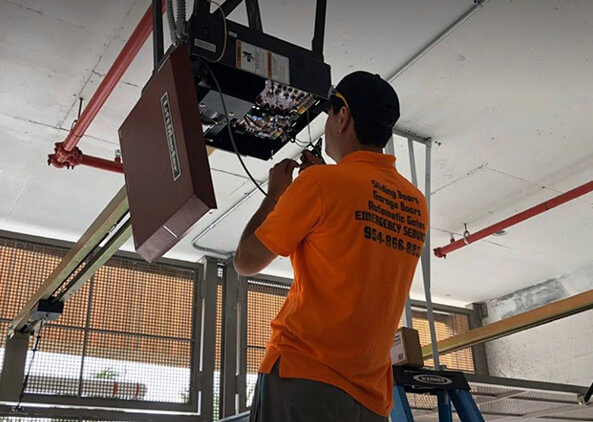
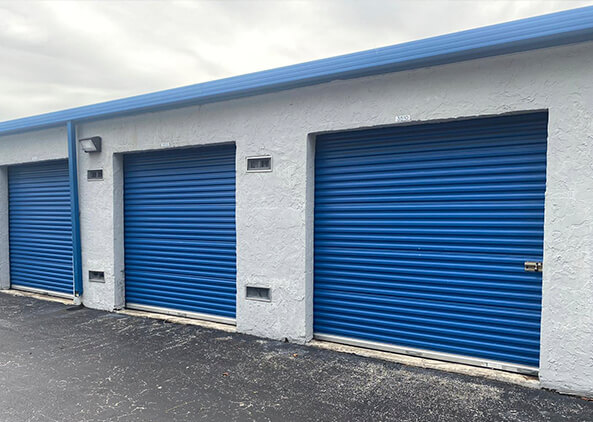
Parts Staged on Every Truck: Because a Loading Dock Can't Wait
The goal on every commercial call is a single-visit close. We stock torsion springs and operator components for common commercial door brands across the fleet, so when you call at 2 AM because the facility is locked out, the answer to "can you fix it tonight?" should almost always be yes.
This isn't a blanket guarantee for every unusual configuration, but on the most common systems across Miami-Dade's warehouse bays, storage units, and NW 7th Avenue retail spaces, we arrive with what the repair requires. A parts run is the exception, not the standard. Our technicians bring 15+ years of Miami-Dade field experience to every call, which is what allows a fast, accurate diagnosis without costly back-and-forth.
Three-Zone Estimates: So You Know Exactly What Failed and What It Costs
Every estimate is separated into three distinct line items, no bundled quotes, no vague "parts and labor" totals. See our full guide to what drives roll-up door repair pricing.
Spring System
Torsion spring type, load rating, and replacement cost as a separate line item. If a spring shows early wear but hasn't fractured, we document it and let you decide, replace now or monitor.
Operator Unit
The motor and gear assembly that drives the drum. If the operator is drawing excess current because the spring is undersized or worn, it shows up in diagnostics, not as a surprise second invoice.
Curtain Assembly
Slat damage, bottom bar condition, and drum alignment each get their own assessment. If three slats need replacement, you won't pay for a full curtain swap.
How a Commercial Emergency Roll-Up Door Repair Works
A facility locked out by a failed roll-up door gets a technician on-site within 45 minutes. Our 24/7 emergency dispatch covers all of Miami-Dade, every day of the year.
Dispatch
Call 954-323-4090. We confirm your location and route the nearest available technician. The 45-minute window covers all Miami-Dade zip codes: the airport zones (33122, 33126), Doral (33172, 33178), Hialeah (33010, 33016), and the NW 7th Avenue corridor.
On-Site Diagnostics
A three-zone assessment on arrival: spring first (tension check, fracture inspection), operator second (current draw, limit switch, signal response), curtain third (slat alignment, bottom bar contact, drum tracking). We work with awareness of loading-dock safety requirements.
Repair Implementation
Work proceeds on the identified zone. For a broken spring: controlled release, matched replacement at correct tension, full cycle test before close. For operator failures: drive-circuit test, control board terminal check, and emergency-release verification before sign-off.
Post-Service Verification
Every repair closes with a full cycle test under load, we confirm the operator isn't straining and the curtain tracks cleanly both ways. The emergency release (the manual override for power or motor failure) is tested on every commercial call. It works when we leave, or the job isn't done.
Compliance and Permit Documentation for Commercial Properties
All commercial roll-up door work is performed in compliance with applicable Miami-Dade building permit requirements. Where permit documentation is required for the scope of repair or replacement, we coordinate that process as part of the job, not as an afterthought. Our commercial automatic door repair services follow the same documentation standards, so every repair is properly recorded for building management and insurance purposes.
Airport Corridor, Doral, Hialeah, NW 7th Avenue, and Countywide
We cover all of Miami-Dade for commercial and residential roll-up door repair. Primary commercial zones include the warehouse corridors near Miami International Airport, the Doral business district, Hialeah industrial properties, the NW 7th Avenue corridor, and Medley. Residential service extends countywide.
Get the Bay Open: Call 954-323-4090
A roll-up door that won't open stops operations. Call or text 954-323-4090 with your location and the symptom: partial lift, no movement, grinding on the way up, whatever you're seeing. We'll dispatch and arrive with the components to close the repair in a single visit. Available 24 hours a day, every day of the year.
Call or Text 877-840-2505Why Facilities Call Us First
Spring, operator, and curtain priced separately.
Stocked for common commercial brands.
Across every Miami-Dade zip code.
Most repairs done on the first trip.
Manual override verified on every call.
Overnight and holidays included.
Get the Bay Back in Service
Tell us your location and the symptom, or call/text 954-323-4090. We'll dispatch within 45 minutes and arrive with springs and operator parts staged on the truck.
Request Service
Frequently Asked Questions About Roll-Up Door Repair
How much does a roll-up door torsion spring replacement cost compared to a full operator swap?
Spring replacement costs significantly less than operator replacement in most cases. The spring is a mechanical component with a predictable part cost matched to the door's load rating; an operator swap involves the motor, gear assembly, and control board, so more parts and more labor. We itemize both zones separately so you see the actual cost difference before any work begins.
Does it matter what size torsion spring goes on a commercial roll-up door?
Yes, spring size must match the door's load rating exactly. A spring sized for a lighter door will fail faster under a heavier curtain. We measure the door weight and opening dimensions before selecting a replacement. Installing the wrong spring is one of the most common reasons a roll-up door needs a second repair within months.
How long does a torsion spring replacement take on a commercial roll-up door?
Most spring replacements on standard commercial doors take one to two hours on-site. We carry springs for common commercial door sizes on every truck, so if the correct spring is on the vehicle, the repair closes in a single visit. Unusual configurations or oversized industrial doors may require a parts run, which we confirm before starting work.
My roll-up door operator light is on but the door won't move, is that a spring problem or a motor problem?
That symptom almost always points to the spring system, not the operator. The operator is receiving power and sending a signal, and the motor is trying to run, but if the torsion spring has broken, the motor can't lift the curtain's full weight alone. We check the spring zone first on every call that presents this way, before touching the operator unit.
Can you give me a three-zone estimate over the phone, or does a technician need to come out first?
A technician needs to inspect all three zones in person before we provide an itemized estimate. Phone descriptions can point to a likely failure zone, but the actual repair scope, especially on commercial doors, requires a hands-on assessment. We dispatch within 45 minutes and provide the three-zone breakdown on arrival, before work starts.
What makes your three-zone estimate different from a standard repair quote?
A standard bundled quote combines parts and labor into one line. Our estimate separates the spring system, operator unit, and curtain assembly into individual line items, each diagnosed and priced independently. You only pay for the zone that failed; if two zones need work, both are listed separately, with nothing absorbed into a single total.